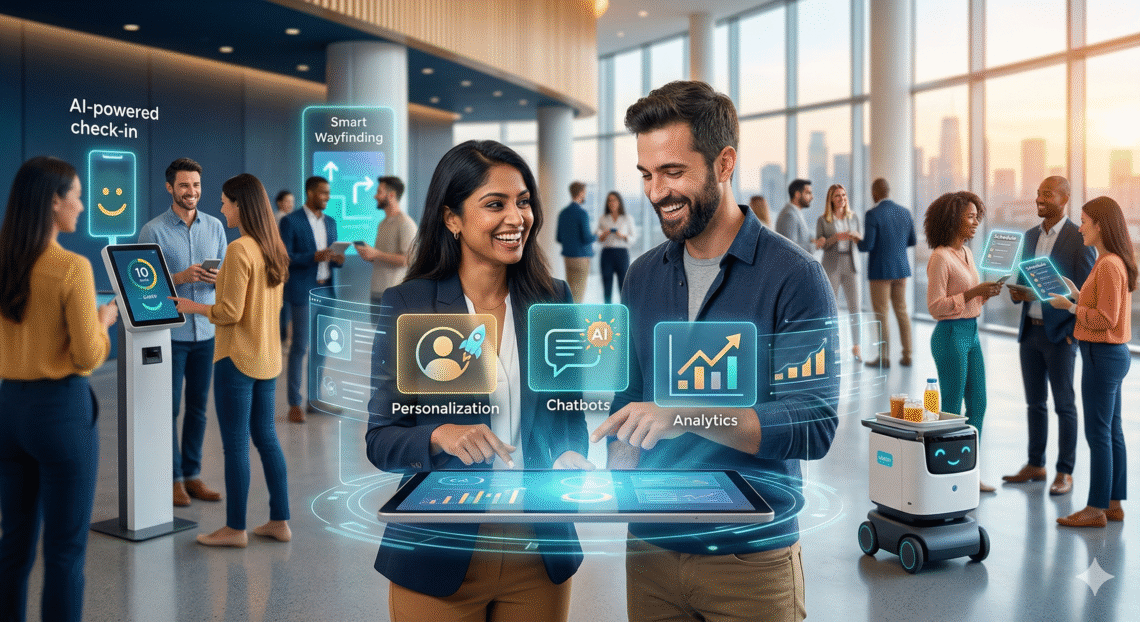
As we look ahead, the shift toward AI for events in 2026 is no longer just a trend; it has become the essential infrastructure that allows planners to scale their creativity without getting buried in manual tasks. We’ve all been there, drowning in spreadsheets and endless email chains just to make a one-day event happen. But lately, the “behind-the-scenes” grind is changing.
Between seamless check-ins and personalized schedules, AI and automation are finally taking over the tedious busywork. The best part? It’s not replacing the human touch; it’s actually giving planners the breathing room to focus on what really matters: creativity and real connection.
Here is how these tools are reshaping the industry and why they’re becoming a planner’s best friend.
The 2026 Shift: Why AI is No Longer Optional
In 2026, AI moved from a “shiny object” to an indispensable co-pilot. Why? Because the old way of planning just doesn’t scale anymore.
The Shift in 3 Sentences:
- Attendees want personalized experiences, not “one-size-fits-all” agendas.
- Clients want data-backed budgets, not “best guesses.”
- Planners are tired of the burnout that comes from juggling 1,000 tiny logistics.
This shift is already visible in the most personal corners of the industry; according to the Zola 2026 First Look Report, 54% of couples now use AI to plan their weddings, a massive 150% jump in adoption from just a year ago.
The Reality Check
We used to fear that technology would make events feel cold or robotic. It’s actually the opposite. By letting automation handle the boring 60% of the job, we finally have the mental energy to focus on the 40% that actually matters: strategy, storytelling, and building a real community.
3. Transforming the Event Lifecycle: A Step-by-Step Look
How exactly does AI change your day-to-day work? Let’s follow the life of an event from the first “Idea” to the final “Report.”
3.1 Planning: Your New AI Co-Pilot
Gone are the days of opening 50 tabs to compare hotel rates. In 2026, Agentic AI acts as your personal research assistant.
- The Win: AI can scan thousands of venues, filter by your specific budget and sustainability goals, and even draft the initial RFPs (Request for Proposals) while you’re at lunch.
- The Human Touch: You stop being a “data searcher” and start being a “decision maker.”
“If you’re looking for tools that act as a true co-pilot, industry leaders are already leaning into platforms like Cvent’s AI Writing Assistant to cut through the noise of manual RFP drafting.”
To see how ‘Agentic AI’ is actually performing in the wild, check out how Fireflies.ai is turning messy vendor calls into structured task lists automatically.
3.2 Logistics: The 10-Second Check-In
We’ve all seen the nightmare: a line of 200 grumpy attendees waiting at a registration desk.
- The Win: AI-powered facial recognition and QR sync mean check-in now takes about 10 seconds. No more franticly searching for badges alphabetically while a line forms out the door.
3.3 Marketing: From “Blast Emails” to “Personal Journeys”
Stop sending the same email to 5,000 people. It’s annoying, and it doesn’t work.
- The Win: AI looks at an attendee’s LinkedIn or past interests and says: “Hey, since you love SaaS marketing, you shouldn’t miss the 2:00 PM session on Room B.” * The Result: Higher ticket sales because the event feels like it was built specifically for them.
While AI handles the data, your message still needs to resonate. If you’re struggling to find the right words, my [Guide to Copywriting that Sells] breaks down how to turn AI-driven insights into actual ticket sales
3.4 The “Live” Experience: Instant Support
“Where is the bathroom?” “Is there vegan food?” “When does the keynote start?”
- The Win: Instead of your staff answering the same question 100 times, an AI Chatbot handles the basics on the event app.
- Pro-Tip: If the AI detects an attendee is frustrated, it can instantly “hand off” the chat to a human staff member to step in.
Boosting your event’s visibility in real-time is easier when you understand the tech behind the feed. Check out my deep dive on [How Social Media Algorithms Work in 2026] to make sure your event’s ‘Live’ moments actually get seen.
3.5 Post-Event: Spreadsheets are Dead
Usually, the week after an event is spent “cleaning up” data. Not anymore.
- The Win: AI turns raw data into actionable stories. Instead of a sheet of numbers, you get a report saying: “Your networking lounge was the most popular spot; you should make it 20% bigger next year.”
4. Beyond Logistics: Inclusion & Planet-First Planning
In 2026, a “successful” event isn’t just one that makes a profit. It’s one that welcomes everyone and leaves a smaller footprint. Here’s how AI is quietly becoming our best tool for “good.”
4.1 AI for Accessibility: Breaking the Language Barrier
We’ve all been to events where someone felt left out because of a language gap or a hearing impairment.
- The AI Win: Real-time AI translation and live captioning are now standard.
- The Result: Whether your guest speaks Kannada, Spanish, or uses sign language, they can follow the keynote in real-time on their own device.
- The Human Touch: You aren’t just “hosting a talk”; you’re building a global conversation where nobody is invisible.
4.2 Smart Sustainability: No More “Food Waste Guilt”
One of the biggest heartbreaks for any event planner is seeing trays of untouched catering go to waste.
- The AI Win: Predictive analytics look at your real-time RSVP data and historical “no-show” rates to tell you exactly how much coffee and lunch to order.
- The Result: You can reduce food waste by up to 30%.
- The Bottom Line: You save thousands of dollars, and the planet (and your client) will thank you for it.
5. Special Spotlight: The AI Wedding Planner
If you’ve ever planned a wedding, you know it’s 10% champagne toasts and 90% chasing vendors and staring at seating charts. In 2026, AI is stepping in as the ultimate “Maid of Honor” to handle the stress.
- Mood Boards to Reality: You can now show an AI your Pinterest board, and it will automatically find local vendors who match that specific aesthetic and—more importantly—your budget.
- The “Seating Chart” Solver: Instead of moving sticky notes around a table for six hours, AI analyzes your guest list (and who shouldn’t sit near who) to suggest the most harmonious layout in seconds.
- Real-Time Guest Concierge: Imagine a WhatsApp bot for your wedding that answers: “Where do I park?” or “What’s the dress code?” at 2:00 AM so you don’t have to.
The Human Win: When the “logistics” are automated, the couple actually gets to be present at their own wedding.
6. The Planner’s Advantage: 3 Big Benefits of Automation
If you’re still on the fence about AI, think of it as a specialized team you don’t have to pay by the hour. Here is how it changes your professional life:
Efficiency: Reclaiming Your Time
The average event planner spends about 60% of their time on repetitive admin tasks—emails, data entry, and hunting for venues.
- The AI Win: In 2026, generative AI can slash content creation time (like website copy and speaker bios) by 75%.
- The Bottom Line: You aren’t just “faster”; you’re reclaiming roughly 5 to 10 hours a week to actually focus on high-level strategy.
Accuracy: Goodbye “Human Error”
We’ve all had that heart-stopping moment of realizing a budget formula was wrong or two sessions were double-booked.
- The AI Win: Predictive models can now forecast attendance with 85-90% accuracy.
- The Bottom Line: AI doesn’t get tired, bored, or distracted. It flags budget leaks and scheduling conflicts before they become expensive mistakes.
7. Creativity: From “Admin” to “Experience Architect”
When you aren’t drowning in spreadsheets, your brain finally has the space to be creative again.
- The AI Win: Instead of starting from a blank page, you can use AI to brainstorm three unique event themes or custom “ice-breaker” prompts for networking in seconds.
- The Bottom Line: You stop being the person who “manages logistics” and start being the person who “designs memories.”
Using AI as a co-pilot is essentially like having a digital ghostwriter on your team. If you’re curious about how to use this skill to scale your own business, read my [Complete Guide to Ghostwriting for Beginners]
8. Real-World Impact: A Case Study (Before vs. After AI)
To understand how far we’ve come, let’s look at a typical 500-person corporate conference. Here is what the planning process looked like in 2020 versus how it looks today in 2026.
The “Before” (Manual Planning)
- Sourcing: The planner spent 45 hours researching venues, sending RFPs, and manually comparing PDF contracts.
- Check-in: On the morning of the event, a long queue of 200 people waited at the desk. Average check-in time? 3 minutes per person.
- Networking: Attendees wandered around hoping to meet the right people, often leaving with only a few random business cards.
- Post-Event: The team spent two weeks sifting through paper surveys and Excel sheets to understand if the event was a success.
The “After” (AI-Powered Planning)
- Sourcing: Using Agentic AI, the planner shortlisted the top 5 venues in 15 minutes. The AI even flagged a hidden “service fee” in one of the contracts.
- Check-in: Facial recognition and QR sync reduced check-in to just 10 seconds per person. No lines, no stress.
- Networking: An AI matchmaking tool suggested specific people to meet based on LinkedIn profiles. Networking activity increased by 50%.
- Post-Event: AI analyzed attendee sentiment and session data instantly. The final ROI report was ready before the cleanup crew finished on day one.
The Result: The organizing team reported a 30% reduction in costs and a 20% increase in attendee satisfaction scores.
9. The Reality Check: Challenges & Ethical Concerns
As much as I love how AI simplifies my life, we have to be honest: it’s not perfect. It’s a powerful tool, but like any tool, it can cause a mess if you don’t handle it with care.
The Data Privacy Elephant in the Room
In 2026, data is more valuable than gold. When you use AI for facial recognition or personalized networking, you are handling sensitive attendee information.
- The Challenge: New regulations (like the EU AI Act and India’s DPDP Act) mean you can’t just “dump” data into any random AI tool.
- The Solution: Always use enterprise-grade tools that guarantee your data isn’t being used to train their public models. Transparency is your best friend—tell your attendees exactly what you’re collecting and why.
Avoiding “AI Fatigue” & The Hallucination Trap
We’ve all seen it: an AI chatbot that confidently gives the wrong directions to the bathroom, or an automated email that sounds a bit too much like a robot.
- The Challenge: AI can “hallucinate” (make things up) or make an event feel cold and impersonal.
- The Solution: Treat AI like a smart intern. It’s great at drafting and sorting, but a human must do the final check. If an email doesn’t sound like you, don’t send it.
The Authenticity Premium
Because AI-generated content is everywhere now, real human connection has actually become more valuable.
- The Challenge: Over-automating can kill the “vibe” of your event.
- The Solution: Use AI for the logistics so you can be more present for the emotions. If you automate the check-in, use that extra time to personally greet your guests.
10. Looking Ahead: Future Trends to Watch (2027 & Beyond)
As we look toward 2027, the question isn’t if we’ll use AI, but how deeply it will be woven into the fabric of our events. We are moving from “AI as a tool” to “AI as an infrastructure.” Here are the three big shifts on the horizon:
The Rise of “Agentic” Portfolios
We’re moving past simple chatbots. The future belongs to AI Agents that don’t just “talk”—they “do.”
- What’s coming: Imagine an AI agent that manages a portfolio of 50 small regional “micro-events” simultaneously—handling the bookings, the speaker contracts, and the local marketing—while you simply oversee the strategy from a dashboard.
The “Blur” (AR & Spatial Computing)
With the maturation of smart glasses and spatial audio, the line between “online” and “offline” is disappearing.
- What’s coming: An attendee in London could “walk” through a trade show floor in Mumbai, seeing the booths in 3D and talking to exhibitors as if they were standing right there. AI will manage the real-time lighting and audio to make it feel seamless.
Authenticity as the New “Luxury”
Because AI can now generate perfect emails, perfect images, and perfect schedules, imperfection and raw human emotion will become the most valuable parts of an event.
- What’s coming: We’ll see a return to “analog” moments, handwritten notes, unscripted fireside chats, and phone-free zones—powered by the time AI has saved us.
Key Takeaways: Your AI Action Plan
If you’re ready to start using AI but don’t know where to begin, keep these three rules in mind:
- Start Small, Not Big: You don’t need a million-dollar tech stack. Start by using AI to draft your event emails or summarize your post-event surveys. Build your confidence first.
- Privacy is Non-Negotiable: Before you upload any attendee data, check the “Privacy Settings.” Make sure the tool you are using isn’t “learning” from your private client info.
- Keep the “Human” in the Loop: AI is a brilliant assistant, but a terrible boss. Always have a human review the final schedule, the tone of the emails, and the “vibe” of the event.
Conclusion: The Future is Human-Centric
The meetings and events industry is changing faster than ever, but the core mission remains the same: bringing people together. AI and automation aren’t here to replace the magic of a live event; they are here to remove the friction that gets in the way of that magic. By embracing these tools, we aren’t just becoming “techier”—we’re becoming more available. More available for our clients, more available for our attendees, and more available for the creative ideas that make an event truly unforgettable.
The future of events isn’t just “smart”, it’s more human. Are you ready to lead the way?
Need a hand navigating the AI revolution? > Technology can handle the logistics, but it takes a human to craft the experience. If you’re looking for a SaaS/Martech writer who can translate complex tech into human stories, or an SMM to boost your event’s reach, let’s talk.

