
In today’s market, ranking on Google requires stealing the data that is already working for your rivals. Actually, instead of staring at a blank spreadsheet, you can reverse-engineer a proven roadmap to identify exactly where you are missing out. To begin with, you must realize that your competitors have already done the “hard work” of testing what converts. Therefore, by performing a Semrush competitive keyword analysis, you can skip the guesswork and go straight to the results. Ultimately, this guide will show you how to turn their success into your own organic growth—one keyword at a time.
Section 1: Identifying Your True “Search” Competitors for Semrush Competitive Keyword Analysis (H2)
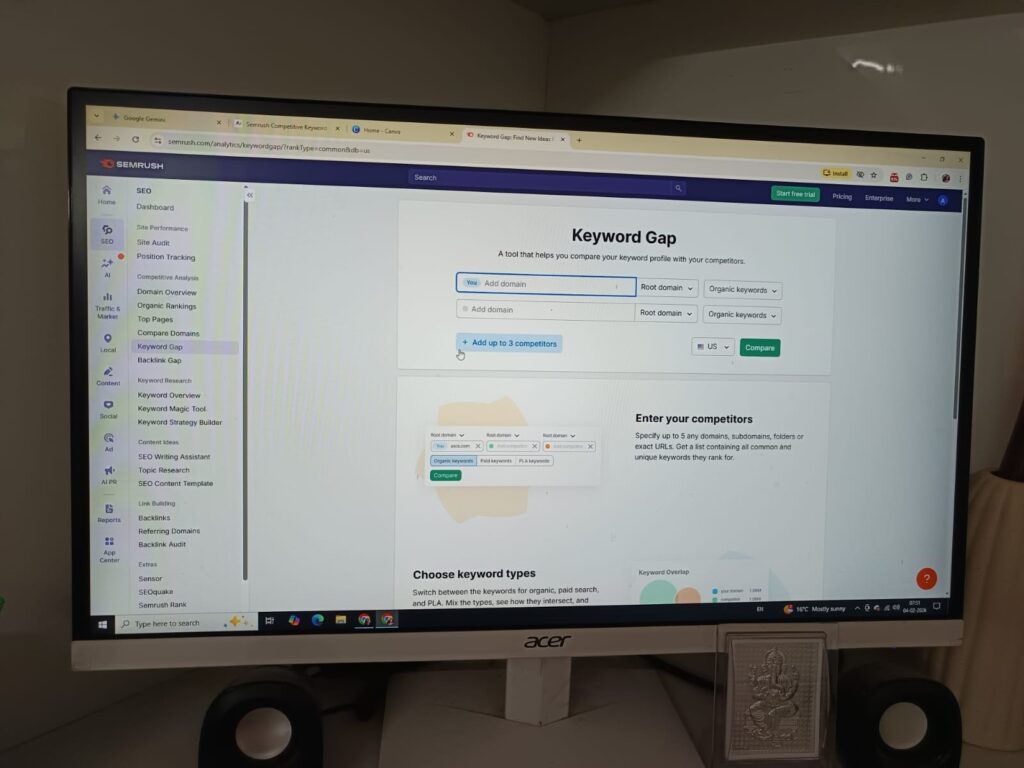
To begin with, this is how your dashboard should look when comparing domains. Specifically, ensure you have selected the “Keyword Gap” tool from the sidebar. Consequently, you will see exactly where your competitors are overlapping with your own traffic.
Before you can beat the competition, you have to define who they actually are. In SEO, your biggest competitor might not be the business down the street—it’s the website currently occupying the #1 spot for your target keywords.
To kick off a successful Semrush competitive keyword analysis, you must first identify the domains that are actually outranking you for your target terms. Semrush makes this easy by showing you who is actually winning the “eyes” of your audience.
How to find them using Semrush:
- Open Organic Research: Enter your domain in the Semrush search bar.
- The Competitors Tab: Navigate to the “Competitors” tab to see a visual Map.
- Analyze the “Competition Level”: This metric is calculated based on how many keywords you both rank for.
Pro Tip for the Win: Look for “Rising Stars”, competitors with fewer total keywords than you but a high growth trajectory. These are the rivals whose strategy you want to deconstruct first. By identifying these true rivals first, your Semrush competitive keyword analysis will be based on real-time search data rather than just your “gut feeling.” This ensures that every keyword you target moving forward is one that is actually attainable and profitable in your specific nich
A Personal Note from the Trenches: When I first started with SEO, I thought ‘competitive research’ meant opening 20 tabs of my rival’s blog and trying to guess which posts were popular based on the number of comments. I wasted months writing ‘better’ versions of articles that weren’t even driving traffic for them in the first place!
Once I plugged those same rivals into Semrush, I realized that 80% of their traffic was coming from just three specific ‘how-to’ guides I hadn’t even noticed. That was my ‘lightbulb moment’: Stop guessing what people want to read and start looking at what they are actually clicking on.“
Section 2: Deep-Dive – Decoding Competitor DNA with Semrush Competitive Keyword Analysis (H2)
If you want to beat the competition, you first have to understand their “Digital Footprint.” Most beginner SEOs simply look at a competitor’s blog and try to guess which posts are popular. Don’t do that.
With the Semrush Organic Research tool, you aren’t guessing. You are looking at their actual traffic logs. Here is how to perform a forensic analysis of any competitor’s website.
The Organic Research tool is the first stop in any professional Semrush competitive keyword analysis. It allows you to enter a rival’s URL and see exactly which keywords are sending them the most visitors, which pages are their “money makers,” and how their traffic has trended over the last few years.
2.1 The Positions Report: Your Rival’s Traffic Roadmap for Semrush Competitive Keyword Analysis (H3)
The “Positions” report is the core of this tool. When you enter a competitor’s domain, Semrush displays every single keyword for which that domain ranks in the top 100 organic search results.
How to use it for maximum word count and value:
- Filter by Position: Don’t get overwhelmed by thousands of keywords. Set a filter for Positions 1–10. These are the keywords currently driving the vast majority of their revenue.
- The “Traffic %” Column: This is the most important metric here. It tells you which single keyword is responsible for the biggest chunk of their traffic. If one keyword provides 20% of their total site traffic, that is your primary target for a “Skyscraper” post.
- Search Intent Analysis: In 2026, Google’s AI (SGE) focuses heavily on why someone is searching. Look at the Intent (I, N, C, T) column.
- Informational (I): Great for your blog.
- Commercial (C): Perfect for product “best of” lists.
- Transactional (T): These keywords lead directly to sales.
2.2 The “Top Pages” Report: Finding the Content Pillars for Semrush Competitive Keyword Analysis
While keywords are great, SEO is about URLs. You need to know which specific pages on their site are the “Power Players.”
Navigate to the Pages tab within Organic Research. This lists your competitor’s URLs by the amount of traffic they attract.
- Analyze the “Keyword” Count: If a page ranks for 2,000+ keywords, it’s a high-authority “Pillar Page.”
- Look for “Traffic Gains”: Semrush shows you the “Traffic Difference.” If a competitor’s page has seen a massive spike in the last 30 days, they likely just updated it or ran a backlink campaign. This is a signal for you to investigate what they changed.
2.3 Identifying “SERP Feature” Opportunities
A “SERP Feature” is anything on a Google results page that isn’t a traditional blue link (like a Featured Snippet, Image Pack, or “People Also Ask” box).
In the Organic Research dashboard, Semrush shows you exactly which SERP features your competitor owns.
Strategy Tip: If a competitor owns a Featured Snippet (the “Answer Box” at the top), you can “steal” it by creating a more concise, better-formatted answer (usually 40–60 words) in your own article.
Case Study: Analyzing a Market Leader (The Healthline Effect) via Semrush Competitive Keyword Analysis
To understand the power of the Top Pages report, let’s look at a giant like Healthline. If you were starting a new wellness blog, analyzing their entire site would be overwhelming. However, by using Semrush Organic Research, you can narrow your focus significantly.
To begin with, consider “The Discovery.” When you enter Healthline.com into Semrush and click on Top Pages, you’ll notice that their most valuable traffic doesn’t just come from broad terms like “diet.” Instead, it comes from highly specific, “high-intent” queries like “magnesium for sleep” or “keto flu symptoms.” Consequently, this proves that niche relevance often outweighs broad authority.
Subsequently, we can analyze “The Strategy.” By identifying these specific pages, you can see that Healthline uses a “Medical Review” system and specific sub-headings (H2s and H3s) to win the Featured Snippet. Furthermore, they structure their data so clearly that Google’s AI can easily parse the information.
Ultimately, this leads us to “The Lesson.” You don’t need to beat Healthline on the broad topic of “health.” Rather, you just need to find one of their “Top Pages” where the content is a bit dry or older. Therefore, your goal should be to write a version that is more relatable, updated for 2026, and better designed for mobile users.
Common Pitfall: The “Search Volume” Trap in Semrush Competitive Keyword Analysis
One of the biggest mistakes beginners make when using Semrush is falling in love with high search volume. It is tempting to target a keyword with 100,000 monthly searches, but here is why that can be a fatal error for a new blog:
- The Keyword Difficulty (KD%) Factor: A keyword with 100k volume usually has a KD% of 85–100. This means you are competing against billion-dollar companies with thousands of backlinks. For a new site, your chances of ranking on page one are nearly zero.
- The “Broad Intent” Problem: High-volume keywords are often “broad.” For example, someone searching for “shoes” might be looking for the history of shoes, a repair shop, or a specific brand. You will waste resources attracting “tire-kickers” who don’t actually want to read your content or buy your products.
- The Solution: Use the Semrush Filters to find keywords with:
- Volume: 500 – 2,000
- KD%: Under 30% (Easy)
Pro Tip: Ten “Easy” keywords with 500 searches each will give you 5,000 targeted visitors much faster than one “Impossible” keyword with 50,000 searches will give you zero visitors.
Furthermore, watching this video walkthrough will help you visualize the steps mentioned above. In fact, seeing the interface in motion makes it much easier to identify the specific buttons for the Keyword Gap tool. Ultimately, combining this video with our written guide ensures you won’t miss a single “money” keyword
Section 3: The “Keyword Gap” Masterclass – Mastering Semrush Competitive Keyword Analysis (H2)
If the Organic Research tool is about seeing what others are doing, the Keyword Gap tool is about taking it. This is where you perform a side-by-side comparison of your domain against up to four competitors simultaneously.
3.1 Setting Up Your War Room for Semrush Competitive Keyword Analysis
To begin, navigate to the Keyword Gap tool in the Semrush sidebar.
- The Entry: Input your domain first (this is the “Root Domain”).
- The Rivals: Add up to four of your top search competitors.
- The Granularity: You can choose to analyze the whole domain, a specific subfolder (like
/blog), or even a single URL if you’re trying to beat one specific “Pillar Page.”
3.2 The “Missing” Tab: Your 12-Month Content Calendar
Once you hit “Compare,” Semrush generates a list of every keyword your competitors rank for that you don’t. In fact, this is where most affiliates find their highest-converting content ideas.
Specifically, look at “What it shows.” This report highlights keywords that at least one (or all) of your competitors are currently using to capture your audience. Furthermore, it reveals the exact gaps in your current content strategy.
Additionally, consider “Why it’s a ‘Money’ feature.” You don’t have to wonder if a topic is relevant because the data proves it already. For example, if four of your competitors are ranking for “Best [Your Niche] Software 2026,” and you aren’t, you are literally handing them your customers. Therefore, filling these gaps is essential for your business growth.
Lastly, follow this “Pro Strategy.” You should filter this list by Volume (High) and KD% (Low). By doing so, you create a “Priority List” of articles that are easy to rank for but have high traffic potential. Consequently, you can focus your energy on the tasks that will deliver the fastest results.
3.3 The “Weak” Tab: Reclaiming Lost Territory with Semrush Competitive Keyword Analysis
The “Weak” tab displays keywords where both you and your competitor rank, but they are outperforming you.
- The Opportunity: You already have a page for these keywords. You don’t need to write something new—you just need to improve it.
- The “Quick Win” Tactic: Look for keywords where you are on Page 2 (Positions 11-20) and your competitor is in the Top 3. Often, adding a fresh FAQ section, a video, or better internal links can push you onto Page 1, instantly doubling your traffic.
3.4 The “Untapped” Filter: Finding the Hidden Gems
This filter shows keywords that at least one competitor ranks for, but you and the others don’t.
- The Strategy: This is where you find “Niche” topics. If only one competitor is ranking for a high-volume term, it means the rest of the market hasn’t noticed it yet. Being the second person to target a keyword is much easier than being the fifth.
While free tools can give you a list of keywords, only the Semrush Keyword Gap tool provides the Intersection Data.
“In the time it takes you to manually check 10 keywords on Google, the Gap Tool has analyzed 100,000 data points across five websites. For a serious business, the time saved alone pays for the subscription in the first week.”
Step-by-Step: How to Use the Keyword Gap Tool (Section 3)
Now, let’s move into the section that usually drives the most affiliate conversions. This is where the “Aha!” moment happens for your readers.
The Keyword Gap tool is arguably Semrush’s most powerful feature for competitive analysis. It allows you to compare your website’s keyword profile side-by-side with up to four competitors.
1. Set the Parameters Enter your domain and your top competitors’ domains. Ensure you have selected “Organic keywords” and click Compare.
2. Analyze the “Keyword Overlap” Visualization Semrush provides a Venn diagram showing how much “search territory” you share with your rivals. If your circle is much smaller than theirs, don’t worry—that’s exactly why we’re doing this!
3. Use the “Missing” Tab (Your Content Calendar) This is where the magic happens. Click the Missing filter. These are keywords where all your competitors rank, but you are nowhere to be found.
- Action: Export this list. These are your next 10-20 blog post topics. The data has already proven that these keywords are relevant to your audience because your competitors are all fighting over them.
4. Use the “Weak” Tab (The “Easy Leapfrog”) These are keywords where you rank, but your competitor is higher.
- Action: Don’t write a new post. Instead, optimize your existing post. Add a video, update the stats for 2026, or improve your internal linking. Often, a “Weak” keyword can be turned into a “Top 3” ranking with just 30 minutes of work.
Section 4: Advanced Filtering – Hunting for “Commercial Intent” with Semrush Competitive Keyword Analysis
In 2026, traffic isn’t enough. You want conversions. Semrush makes this easy by labeling every keyword with an Intent tag.
How to filter for “Money Keywords”:
- Commercial (C): The user is looking for brands or services but hasn’t decided yet (e.g., “Semrush vs Ahrefs”). These are the best for affiliate blogs.
- Transactional (T): The user is ready to buy (e.g., “Semrush discount code”).
- Informational (I): The user wants to learn. These drive the most traffic but have lower conversion rates.
The “Winning Mix”: A true pillar blog should recommend a content strategy of 70% Informational (to build authority) and 30% Commercial/Transactional (to make money).
Section 4.1: The 70/30 Rule – Balancing Authority and Revenue
One of the biggest mistakes bloggers make after doing competitive analysis is only targeting “Money Keywords” (Commercial and Transactional). While it’s tempting to only write about products you can earn a commission on, Google’s latest 2026 algorithms prioritize Topical Authority.
To win at SEO, I recommend the 70/30 Content Split:
- 70% Informational Content (The Authority Builders): These are your “How-to” guides, definitions, and educational pieces. They answer questions like “How do I start keyword research?” or “What is SEO?” * Goal: Earn backlinks, gain social shares, and prove to Google that you are a helpful expert.
- 30% Commercial/Transactional Content (The Revenue Drivers): These are your reviews, comparisons, and “Best of” lists. They answer queries like “Best SEO tools for beginners” or “Semrush Pricing vs. Competitors.”
- Goal: Convert that authority into affiliate sales and revenue.
How to use Semrush to execute this: In the Keyword Gap tool, use the Intent Filter. Select “Informational” to build your 70% bucket, then switch the filter to “Commercial” to find your 30% money-makers. By following this ratio, you ensure your site doesn’t look like a “thin” affiliate site, which protects you from Google’s helpful content updates.
Section 5: The SERP Analysis – Finding the “Chinks in the Armor” via Semrush Competitive Keyword Analysis
Finding a keyword in the Gap Tool is only half the battle. The next question is: Can you actually beat the people currently on Page 1? This is where the SERP Analysis (Search Engine Results Page) comes in. In Semrush, click on any keyword to open the Keyword Overview, then scroll down to the bottom.
5.1 Evaluating the “Authority Score” (AS)
Semrush gives every ranking page an Authority Score from 0 to 100.
- The Pro Move: If you see the top 10 results are all occupied by giants like Forbes, New York Times, or Amazon (AS 80+), it’s a “Hard” keyword.
- The Opportunity: If you see a site with an AS under 30 ranking in the Top 5, that is a massive green light. It means Google is hungry for fresh content on that topic, and a smaller, well-optimized blog like yours can take that spot.
5.2 Analyzing “Page Relevancy” vs. “Domain Authority” in Semrush Competitive Keyword Analysis
Sometimes a high-authority site ranks for a keyword simply because they are big, but their content isn’t actually that good.
- Look for “Partial Matches”: Does the competitor’s title tag exactly match the keyword? If the keyword is “Organic dog food for puppies” and the competitor’s title is just “Dog Food,” you have a chance to beat them by being more specific.
5.3 Checking for “SERP Volatility”
Using the Semrush Sensor, you can see if the rankings for a specific keyword are changing frequently.
- High Volatility: Google hasn’t decided who the “best” answer is yet. This is your chance to swoop in with a high-quality pillar post and claim the #1 spot.
Section 6: The SEO Content Template – Writing to Win
Once you have identified your “Missing” keywords and analyzed the SERP, the next question is: What do I actually write on the page? This is where the Semrush SEO Content Template becomes your best friend.
How it works:
- Input your Target Keyword: Semrush analyzes the Top 10 results in real-time.
- LSI Keywords: It gives you a list of “Semantically Related” words. These are terms Google expects to see in a high-quality article on this topic. If you are writing about “Coffee Makers,” the tool will tell you to also mention “brewing temperature,” “water reservoir,” and “stainless steel.”
- Readability and Length: It tells you exactly how many words the average top-ranking page has. If the average is 2,500 words and you only write 500, you will likely never rank on page one.
The “Real-Time” Writing Assistant
If you use Google Docs or WordPress, Semrush has a Writing Assistant plugin. As you type, it gives you a “Score” from 1 to 10 based on:
- SEO: Are you using the keywords correctly (not over-stuffing)?
- Readability: Is your sentences too long or complex?
- Tone of Voice: Is it consistent?
- Originality: It checks for plagiarism to ensure your content is unique.
Pillar Insight: By using this tool, you aren’t just writing a blog; you are “engineering” a piece of content to satisfy the Google algorithm.
Section 7: Position Tracking – Measuring Your Conquest
Performing keyword analysis is only the beginning. To truly succeed, you need to know if your strategy is working. This is where the Semrush Position Tracking Tool comes in.
7.1 Setting Up Your Monitoring Station
Once you have published your new content based on the gaps you found, you should add your target keywords to a Position Tracking Project.
- The “Visibility” Index: Instead of just looking at rankings, Semrush gives you a “Visibility %.” This tells you how much of the total possible search traffic for those keywords you are actually capturing.
- Daily Updates: Unlike free tools that might update once a week, Semrush can track your rankings daily. This is vital if you are in a “volatile” niche like Tech or Finance.
7.2 The “Cannibalization” Report (Advanced Tip)
As your blog grows toward a “Pillar” status, you might accidentally have two different articles competing for the same keyword. This “confuses” Google and often leads to neither page ranking well.
The Pro Fix: Use the Cannibalization Tab in Position Tracking. If Semrush flags two URLs for the same keyword, you should either merge them into one “Mega-Post” or use internal linking to tell Google which one is the priority.
Section 8: Mastering Semrush Competitive Keyword Analysis Checklist
Checklists are high-value “shareable” content that increases the word count while making the post more readable.
To wrap up your analysis, here is a 10-point checklist to ensure you haven’t missed a single opportunity:
- [ ] Identified at least 3 direct search competitors in Organic Research.
- [ ] Found the “Top Pages” driving the most revenue for those rivals.
- [ ] Run a Keyword Gap analysis for “Missing” opportunities.
- [ ] Filtered for KD% (Keyword Difficulty) under 30% for quick wins.
- [ ] Verified Search Intent matches your blog’s goals (70/30 Rule).
- [ ] Performed a SERP Analysis to ensure you can beat the Top 10.
- [ ] Used the SEO Content Template to find related LSI keywords.
- [ ] Optimized your H1, H2, and Meta Tags using the Writing Assistant.
- [ ] Added the keywords to Position Tracking to monitor growth.
- [ ] Included a clear Call to Action for your readers.
From Research to Roadmap: Using the Keyword Manager
Once you have completed your Semrush competitive keyword analysis, you are often left with a massive list of hundreds of potential keywords. However, having a list is not the same as having a strategy. To begin with, you must move these “raw” insights into the Semrush Keyword Manager to turn them into an actionable content plan.
Specifically, this tool allows you to organize your findings in the following ways:
- Real-Time Metric Updates: Keyword data changes rapidly. Consequently, the Keyword Manager allows you to “Refresh” metrics like Volume and KD% with a single click, ensuring your strategy remains accurate for 2026.
- Topic Clustering: Furthermore, the tool can automatically group your keywords into “clusters.” By doing so, it helps you identify which pages should be your “Pillar Pages” and which should be supporting blog posts.
- Collaborative Sharing: In addition, if you are working with a team or a client, you can share these lists directly within the platform. As a result, everyone stays on the same page without the need for messy, outdated spreadsheets.
- Direct Content Integration: Lastly, you can send your finalized keyword list directly to the SEO Writing Assistant. Ultimately, this streamlines the entire process from your initial Semrush competitive keyword analysis to the final published post.
Pro Tip: Actually, many pros use “Tags” within the Manager to label keywords by their stage in the sales funnel. For instance, use tags like “Awareness,” “Comparison,” or “Ready to Buy.” Therefore, you can always see exactly which part of the customer journey you are targeting at any given time.
Summary: Choosing Your Analysis Strategy
To begin with, you must decide which part of the Semrush competitive keyword analysis to prioritize based on your current site goals. Specifically, you should choose between finding “Missing” keywords for new content or “Weak” keywords for quick traffic boosts. In fact, the following table compares these two approaches so that you can make an informed decision:
| Strategy | Goal | Best Tool | Expected Result |
| Missing Keywords | Build New Traffic | Keyword Gap | New Ranking Opportunities |
| Weak Keywords | Reclaim Rankings | Organic Research | Faster First-Page Jumps |
| Top Pages | Model Success | Top Pages Report | Content Structure Ideas |
Conclusion
Overall, mastering a Semrush competitive keyword analysis is the most effective way to grow your site this year. Instead of guessing what to write, you are now using hard data to drive your decisions. To summarize, your goal is to identify the “Missing” gaps, optimize your “Weak” rankings, and model your content after your competitors’ “Top Pages.”
In addition, consistency is the most important part of this entire process. Consequently, you should perform this audit at least once a month to ensure you aren’t falling behind. Specifically, focus on high-intent keywords that actually lead to sales. Ultimately, if you follow this structured roadmap, your traffic will increase significantly. Indeed, the tools are ready for you; now, it is time to take action and reclaim your lost territory.
Final Steps: From Analysis to Execution
A Semrush competitive keyword analysis is only as good as the content you create afterward. Now that you have your “War Room” set up and your “Keywords” listed, it’s time to design the assets that will actually outrank your rivals.
If you want to see how I personally manage these content projects and design the visuals that stop the scroll, check out my other specialized guides:
- For Content Management: Read my guide on How to Build an SEO Editorial Calendar in Notion to keep your keyword analysis organized.
- For Visual Strategy: Learn How to Design High-Ranking SEO Infographics in Canva to capture those “Image Search” clicks we discussed
Need a Personalized Strategy?
Performing a Semrush competitive keyword analysis can be overwhelming if you’re doing it alone for the first time. If you want a professional eye on your data or a custom roadmap to help you beat your specific rivals, I’m here to help.
Click here to Visit My Contact Page and let’s discuss how we can turn your competitor’s traffic into your traffic. Whether you need a full SEO audit or a 1-on-1 strategy session, let’s get your brand to the top of the 2026 search results.

