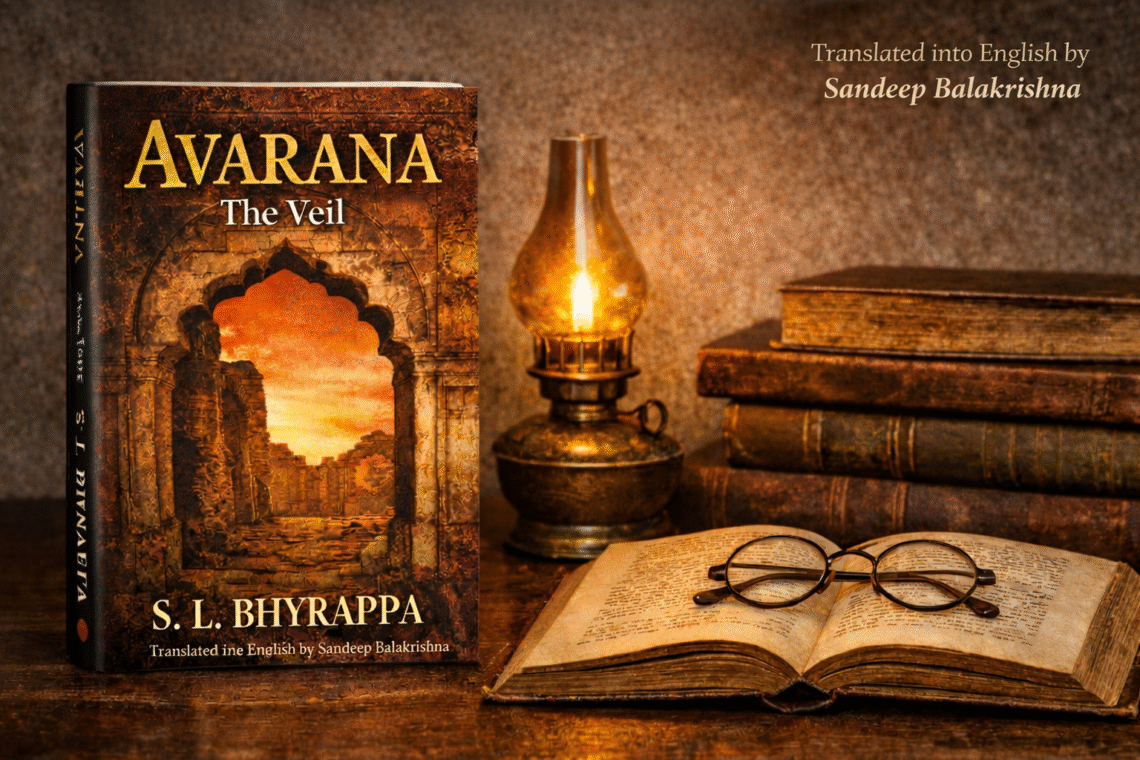
Some books keep us entertained for a few days. Avarana by S.L. Bhyrappa is not one of them. This book stays in your mind, disturbs your peace, and forces you to question what you’ve always believed.
This post contains affiliate links. If you purchase through these links, I may earn a small commission at no extra cost to you.
When I started reading it, I thought it would be another historical novel. But within a few chapters, I realized it was something far deeper: a journey into truth, faith, and human weakness.
This is not a simple review. It’s my honest reflection on how I felt about each character, what I agreed with, what I didn’t, and what I believe Bhyrappa really wanted to say.
A Brief Summary
Lakshmi, an educated woman working in the film industry, marries Amir, a Muslim man, despite her father’s strong opposition. She is supported by Professor Shastri, a modern intellectual who himself is married to a Western Christian woman.
After marriage, Lakshmi converts to Islam and becomes Razia, a decision she takes willingly, out of love and idealism. Many readers call this love jihad, but I disagree. It’s not that. Lakshmi was not forced or brainwashed; she was confident and made her own choice. Her marriage fails not because of religion, but because of control, ego, and emotional manipulation.
There was no physical abuse, no assault, only subtle domination. Amir’s belief that his culture and religion are superior slowly suffocates her spirit. What hurts her more than his actions is the realization that she had silenced her own voice for love.
After her father’s death, Lakshmi returns to her native place and begins reading the collection of books her father had gathered and researched. Slowly, she develops a deep interest in history and begins her own research.
Differences in her marriage gradually distance her from Amir, though she tries hard to adjust. Later, she discovers that Amir has secretly married another woman. Her son, studying abroad, becomes her only emotional link and when he too is away, Lakshmi finds solace in her reading and research.
When she steps out of the marriage, it’s not dramatic. It’s quiet but powerful. She walks away not just from her husband, but from illusion itself.
Later, Lakshmi starts researching history and realizes how many truths have been softened, hidden, or rewritten to please certain ideologies. Her personal story becomes a reflection of the book’s title Avarana, which means covering.
Through her studies, she realizes the hypocrisy of Professor Shastri, whose modern views and public image do not match his inner beliefs about Hindu culture. Lakshmi wishes to expose this duality, but cannot, as he is far more influential. Determined, she compiles her findings into a book and publishes it herself. Her book, however, is banned by the government, leading to her arrest and the confiscation of all her research materials including her father’s precious collection.
This is the story of Avarana, a tale of truth, faith, courage, and the silencing of voices that question established narratives.
The Characters and My Reflections
Lakshmi / Razia — The Seeker and the Sufferer
Lakshmi is one of the most powerful female characters I’ve read. She’s educated, courageous, and determined to find truth yet she’s deeply human.
I admired her strength, but I was also angry with her at times.
When she allowed Amir back into her life toward the end, I felt she shouldn’t have. After everything she faced the manipulation, humiliation, and heartbreak she deserved freedom, not forgiveness.
And yet, maybe that’s Bhyrappa’s message that true strength sometimes lies in calmness, not revenge. Still, my heart wanted her to walk away completely.
Her closeness with the professor also made me pause. It showed another side of her loneliness, vulnerability, seeking warmth and understanding. It was not love, it was needed. That kissing incident in the car scene reminded me that truth-seekers are not perfect saints; they are humans full of contradictions.
Lakshmi’s journey from Razia back to herself is symbolic of the removal of the “covering,” both from her identity and from history.
Amir — The Mind That Controls
Amir is a well-educated, intelligent man but his intelligence is mixed with ego. He loves Lakshmi, but only as long as she fits his worldview. He speaks of freedom but expects obedience. He represents a type of person who uses ideology to hide insecurity.
Amir, once seen through Lakshmi’s eyes as a charming and broad-minded man, gradually reveals his layered and often troubling personality. Educated and polished, he initially appears progressive, convincing Lakshmi that love transcends religion. But over time, his actions show subtle control, ego, and a deep attachment to cultural superiority. His second marriage, hidden from Lakshmi, exposes his double standards and the imbalance in their relationship.
Amir’s character reflects how societal conditioning and patriarchal pride can slowly overpower love. Yet, Bhyrappa doesn’t paint him entirely as a villain at the end, when he rescues Lakshmi and asks her to list her seized books, we see a flicker of care and remorse. Amir is both victim and agent of his upbringing, a man caught between affection and dominance, modernity and tradition.
I couldn’t sympathize with him when he returned in the end. His change didn’t feel real . It felt like regret without understanding. Lakshmi had already moved beyond him spiritually and intellectually.
Professor Shastri
Professor Shastri is one of the most complex and layered characters in Avarana. He is a renowned intellectual who proudly calls himself modern, progressive, and scientific. He supports
Lakshmi’s marriage to Amir, claiming that religion and culture should not stand in the way of love. Outwardly, he appears to reject rituals, faith, and traditions, often mocking Hindu practices and presenting himself as a symbol of liberal thinking. Yet, as the story unfolds, his hypocrisy slowly surfaces.
When his mother dies, this same man who ridicules rituals quietly travels to Gaya to perform her final rites. This moment strips away his intellectual mask, revealing his inner conflict as a man torn between the modern identity he flaunts and the cultural roots he secretly clings to. His marriage to a Western Christian woman, too, seems less about love and more about proving his modernity to the world. Lakshmi, who once admired him, eventually sees the contradiction between his words and actions.
Through Shastri, Bhyrappa skillfully portrays the double standards of educated elites who pretend to rise above faith but remain trapped by their own insecurities and pretence.
The scene where he kisses her in the car is disturbing showing that even educated men sometimes cross moral lines under the guise of modernity. Lakshmi’s silence in that moment tells how women often learn to normalize what makes them uncomfortable.
The Author’s Intention
S. L. Bhyrappa didn’t write Avarana just to tell a story. His real aim was to bring hidden history into light. But he also knew that plain facts or academic writing wouldn’t reach people’s hearts.
So he did something brilliant. He turned history into a story that could be felt.
Through Lakshmi’s pain, Amir’s arrogance, and their shattered relationship, Bhyrappa shows how truth often hides behind emotional and political coverings the “avarana.”
That’s why I think the story ends abruptly. Lakshmi’s journey was more about inner liberation than external closure. She found the truth and that was her freedom.
The result is a novel that feels both historical and deeply personal. It makes readers uncomfortable but that discomfort is exactly what Bhyrappa wanted.
I feel he wanted readers to feel the weight of forgotten truths, not just read about them.
A Thought in Today’s Context
While writing this review, I couldn’t ignore what’s happening around us. The recent blast in Delhi reminded me how fragile peace still is, how quickly religion becomes a reason for pain instead of compassion.
That’s why Avarana feels even more relevant today. It doesn’t ask us to take sides; it asks us to see clearly. Bhyrappa’s story reminds us that truth and humanity are far greater than any religious boundary.
If anything, this book and our times both urge us to build understanding, not walls.
Ending & Interpretation
The novel ends abruptly. Lakshmi, after months of deep research, finally writes her article exposing the historical truths she has uncovered. But no newspaper dares to publish it., she took courage and prints it as a book herself. Soon after, the government bans it and seizes all her copies including the precious collection of her father’s books that had been her source of knowledge and strength.
The story closes with Amir rescuing Lakshmi from her car and telling her to make a list of the seized books and then, it just ends. There is no closure.
As readers, we are left wondering
Did Lakshmi get arrested?
Did she and Amir reconcile?
Did she recover her books?
Did the ban ever get lifted?
None of these questions are answered and that’s exactly the author’s intention. Bhyrappa uses this abrupt ending to mirror how truth often remains incomplete, silenced, or hidden under layers of politics and fear.
The “list of books” at the end is symbolic. It’s Bhyrappa’s own way of telling readers these are the sources I used; verify history for yourself.
While some might find the ending unsatisfying, I believe it’s powerful. It leaves readers uneasy, forcing them to think long after the last page.
Final Thoughts
I believe Bhyrappa knew that historical essays alone wouldn’t reach common readers. So he wove history into fiction through emotions, relationships, and pain.
He wanted people to feel the truth, not just read it.
That’s why I think the story ends abruptly. Lakshmi’s journey was more about inner liberation than external closure. She found the truth and that was her freedom.
Avarana is not an easy read. It challenges faith, relationships, and comfort zones. But it also rewards readers who dare to question. Avarana is not just about marriage or faith, it’s about the layers of history that have been rewritten to comfort society.
Bhyrappa uses Lakshmi’s research as a metaphor for truth-seeking, tearing the veils of denial one by one.
Before writing this novel, Bhyrappa stayed for five days at author Bhanu Mushtaq’s home to understand Muslim culture deeply. That shows he didn’t write this book out of hate or bias. He was seeking honesty, a balanced picture of history, faith, and human weakness.
Many people label Avarana as “controversial.” But controversy arises when truth feels uncomfortable.
To me, the novel isn’t about Hindu vs. Muslim it’s about truth vs. illusion. Religion isn’t the villain; blind belief is.
Avarana is not an easy read. It challenges faith, relationships, and comfort zones. But it also rewards readers who dare to question.
As a reader and as a woman, I felt anger, admiration, and deep respect while reading it.
Lakshmi’s courage to search for truth, even when it hurts her personally, makes Avarana one of the most unforgettable books I’ve ever read.
Overall, Avarana is a powerful and thought-provoking novel that deserves to be read with an open mind. It may not please everyone, but it surely makes readers question history, faith, and the idea of truth itself. The writing is bold, emotional, and deeply researched.
Though I found the ending abrupt and some characters frustrating, the story stays with you long after you finish it. I would definitely recommend this book to readers who enjoy strong narratives, historical themes, and stories that challenge perspectives. It’s not an easy read, but it’s an important one.
You can find book here( Non Indian) Buy Avarana book Here (Indians)
you can read my other articles here
If you enjoyed reading this review please do share with other readers. Thank you.

